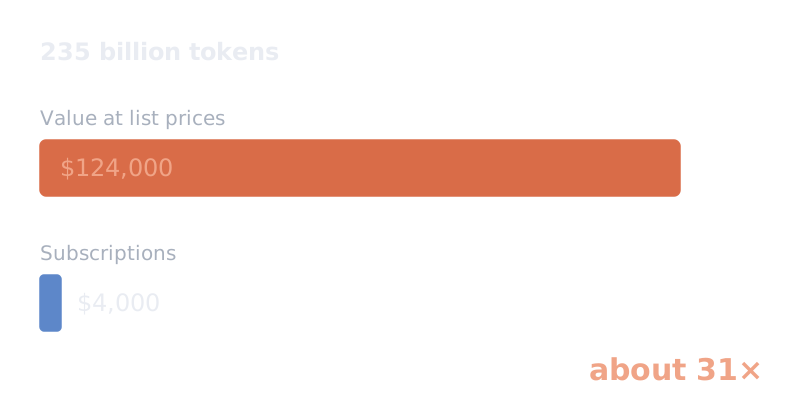
From February to October 2026, my AI coding agents used 235 billion tokens. At API list prices, that usage is worth about $124,000. The subscriptions that ran it cost about $4,000. The usage was worth about 31 times what they cost.
Below is how I measured it, where the value came from, and when a team should still pay for metered API access.
The numbers
| February – October 2026 | |
|---|---|
| Tokens | 235 billion (197 billion in 1.5 million Claude messages, 38 billion on Codex) |
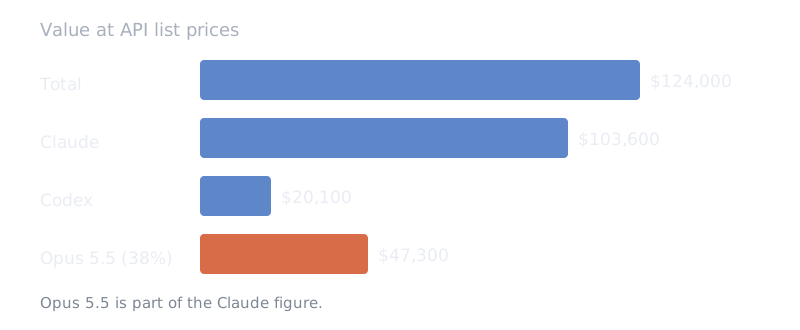
| Value at API list prices | about $124,000 (Claude about $103,600, Codex about $20,100) |
| Subscriptions | about $4,000 (20 seat-months at $200) |
| Ratio | about 31× |
The usage covers my Claude and Codex agent work across several projects. The Claude agents ran in Claude Code and the Codex agents ran in the Codex CLI, each signed in to a flat-rate plan instead of an API key.
To measure it, I wrote a counter. Both tools keep a local transcript of every session with the token counts of each model response, so the counter reads every transcript on the machines that ran agents, including the compressed archives. Agents copied transcripts between machines, so it keeps each message once, by its message id. Each message is priced at the published list price of its model: input, output, cache writes (at 1.25 or 2 times input, by cache duration) and cache reads. Where a provider does not list a cached-input price, I used 0.1 times input.
For seats, I priced every plan at $200 for each month it was in use. A seat-month is one plan for one month, and the count of 20 adds up all the Claude and Codex plans I used over the period.
The result is an estimate, and it is off in both directions. The value is low, because Claude Code deletes transcripts after about 30 days by default. Much of the work before September is gone, so the early months show only a fraction of the real use. The spend is low too, since some Codex work used paid credits beyond the seat price and this total does not include them. DeepSeek ran on its own pay-per-token API and is excluded. That is why I say “about 31×” and treat it as an estimate, not a floor or a ceiling.
Where the value came from
About 97% of the Claude tokens were cache reads: the agent re-reading its instructions, the files it opened and the conversation so far, on every turn. Output tokens were about 0.3%.
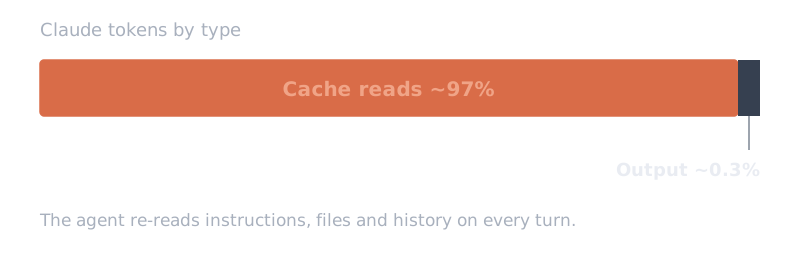
That share decides the economics. On a metered API, a long agent session gets more expensive with every turn because each turn re-reads the history, even at the cache price. On a flat-rate plan, the same re-reading counts against a usage window and not a bill.
The strongest model also did the most work. Claude Opus 5.5 alone was about $47,300 of the value, 38% of the total. It did the planning, the reviews and the changes where a mistake costs the most. On a metered API I would have pushed much of that work to cheaper models for cost alone, not for quality.
What flat-rate plans cost in other ways
A subscription is not free capacity. It moves the limit from money to time. Each account has a five-hour window and a weekly limit. A usage check holds new background agents when an account is close to its usage limit, and they wait for the reset.
Context still matters, because cache reads dominate and a bloated agent burns its window faster. Short briefs and small, one-item builder tasks keep each window productive. Cheap models matter too. A small model as builder uses a fraction of the window a large one does, and in a small pilot the small builder also had the fewest review misses.
When to pay for the API instead
Flat-rate plans fit agents that a person runs for their own engineering work, inside the provider’s official tools and within the plan’s limits. I would go to metered API access when the model serves your customers, since a product feature needs its own key, rate limits and billing and not a person’s seat. I would also use it for unattended work at scale, like batch jobs and pipelines with no person behind them. And I would use it when you need guarantees, because API plans give the service levels, data terms and spend controls that a team plan may not.
Read the current terms of each plan before you build on it. Plans and limits change often.
If you want to know your own ratio, run your agents for a month and price the transcripts. It depends on how much your agents re-read. And keep your transcripts longer than 30 days. I lost most of my early data to the default.
Want help setting up an agent fleet that stays inside its budget? Email hello@jeffkent.dev.